For Economic recovery Corps Fellows, hosts, community partners and ERC partners
Ripple Effects Mapping for the Economic Recovery Corps — Capture Your Impact, Energize What's Next
A participatory, story-driven approach to understanding impact, strengthening partnerships, and sparking collective learning and action
Three 2-hour video conference sessions — recorded in case you want to review or need to miss a session
Workshop 1: Thursday, May 21 — 11 am -1 pm ET
Workshop 2 Friday, May 29 — 1-3 pm ET
Workshop 3 Monday, June 1 —11 am -1 pm ET
You've spent many months embedded in your host community, building relationships, moving projects forward, and navigating the messy, nonlinear work of economic recovery. But how do you capture what's actually happened — the connections made, the momentum built, the ripples you may not even know you've started?
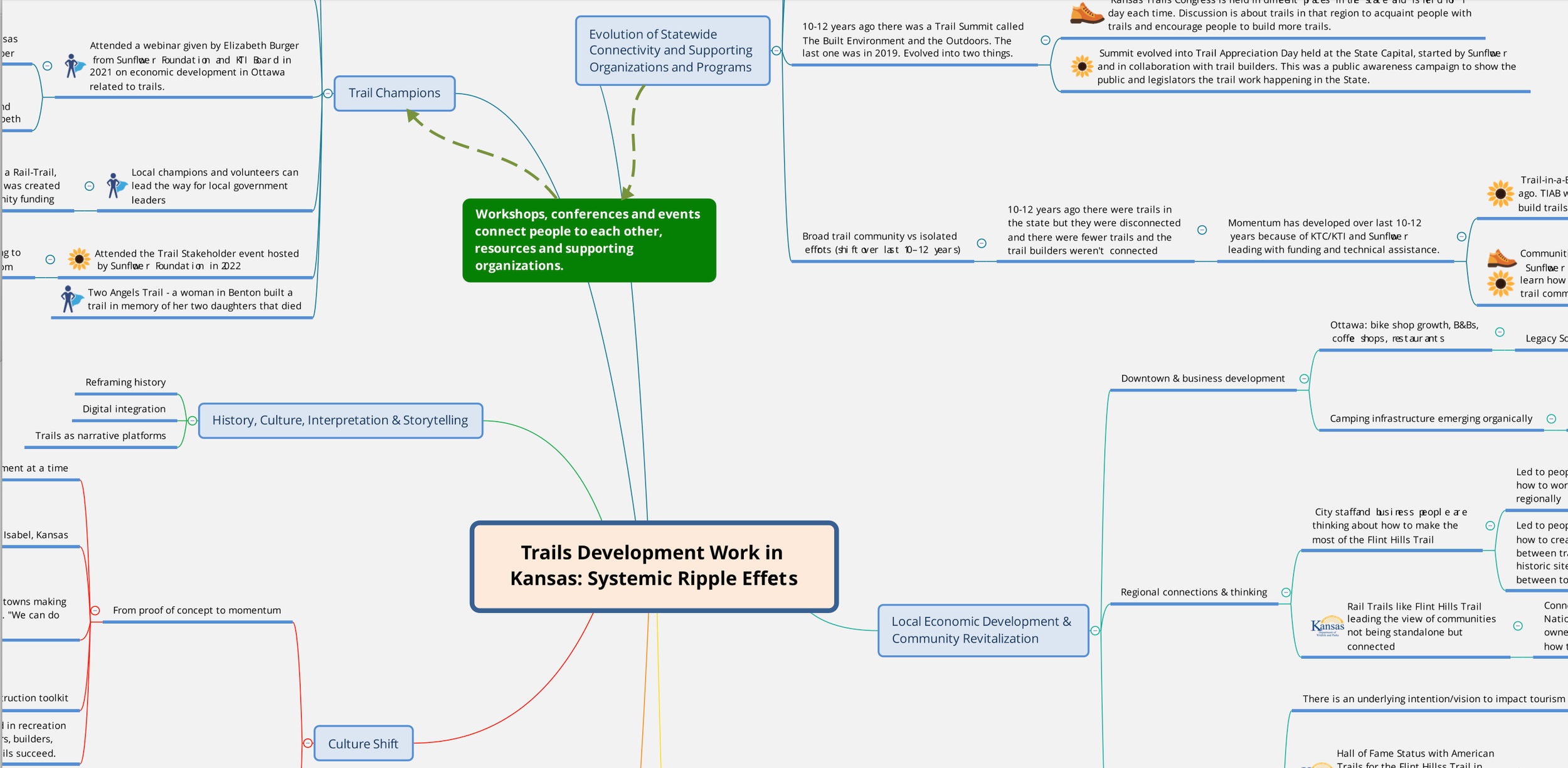
This three-session workshop introduces Ripple Effects Mapping (REM), a participatory evaluation and learning tool that helps communities and organizations surface the full scope of their work — including outcomes that never make it onto a logic model. Designed specifically for Economic Recovery Corps fellows, hosts, community partners, and ERC partners, this series uses your own projects and experiences as the foundation for learning.
Over three 2-hour sessions, you'll experience REM firsthand, learn to design and facilitate your own sessions, and practice translating stories and connections into insights and next steps. The goal isn't just evaluation — it's helping your host community and partners see how far the work has reached, recommit to what's been started, and carry that momentum forward after the fellowship ends.
Whether you're a fellow preparing to transition out, a host organization thinking about sustainability, or a community partner wondering what comes next — REM offers a structured, energizing way to look back at what you've built together and forward to what’s possible.
WHO IS THIS course FOR?
This course is specifically for ERC and its/your extended networks including partners in fellowship-related projects. Ripple Effects Mapping is used in a wide range of settings by a variety of practitioners including:
Extension, community and economic development professionals
Community and service organizations
Nonprofit and foundation program managers
Local government officials and staff
Facilitators, evaluators, and network coordinators
Chambers of Commerce & business alliances
Place-based & conservation organizations
Historic preservation groups
Downtown & Main Street groups
Community leaders
Anyone who wants to strengthen partnerships, understand community impact, or use participatory approaches for reflection, communication, and decision-making
What You’ll Gain
First-hand experience with a live Ripple Effects Mapping session
A clear, adaptable framework for planning and facilitating REM
Strategies for crafting effective appreciative inquiry questions
Tools and resources for using REM results in evaluation, learning, and collaborative planning
Examples of how others have adapted REM for diverse contexts (community initiatives, collaborative networks, organizational learning, multi-stakeholder partnerships)
Practice in key REM roles and support for trying REM on your own
Confidence to design and lead a REM session in your own setting
Three Sessions
Three 2-hour live sessions (6 hours total), highly interactive with encouragement for reflection and application to your projects during and between meetings. All sessions include instruction, discussion, examples from practice, and practical planning tools. Sessions are recorded in case you can’t make it to one, or want to review later.
Session 1 – Ripple Effects Mapping Experience + Basics
We'll begin with a mini-REM session where you'll hear stories of impact drawn from real community and organizational work — stories that will likely feel familiar to anyone who has been doing the ground-level work of economic recovery. You'll hear and see how participant stories translate into visible connections, themes, and outcomes — often revealing ripples that go far beyond the original effort. Afterward, a debrief will focus on what makes REM work, the skills of a facilitator, and how the process could be used for other purposes. We'll wrap up with an overview of the main approaches to REM and examples of how the process has been used and adapted.
Session 2 – Designing and Facilitating Ripple Effects Mapping
Session 2 shifts into the design and facilitation side of REM. We'll unpack the elements that shape a strong session — and explore why each one matters. Who you invite into the room shapes what gets surfaced. How you frame your focus questions determines whether people share surface-level updates or dig into what's really changed. Appreciative inquiry interviewing, in particular, is a powerful fit for economic recovery work, where meaningful progress is often relational, incremental, and easy to overlook.
You'll practice crafting appreciative questions, consider options for virtual and in-person formats, and see how small design decisions influence trust, participation, and outcomes. We'll also explore how to tailor REM for different purposes — evaluation, strategic learning, team-building, or partnership development — so you leave with a flexible tool, not just a fixed protocol.
Session 3 – From Mapping to Meaning: Turning Insights Into Action
Session 3 focuses on what happens after the REM conversation. As the fellowship draws to a close, your communities and partners need more than a final report; they need a shared sense of how far they've come and why it's worth continuing. REM can help you create that.
We'll walk through approaches for developing and interpreting a ripple map, translating raw stories and connections into themes, insights, and actionable next steps. You'll see examples of how organizations have used REM findings — not just to document impact, but to re-energize partners and reorient toward what's next. We'll practice REM roles in small groups, treating it as a rehearsal for the sessions you'll facilitate with your own communities. We'll wrap with a coaching conversation to support you in designing a REM process you can actually use — before, during, or after the transition.
COURSE INSTRUCTOR
Michele Archie — Community economics and engagement lead at The Harbinger Consultancy
Session Dates and Times
Three 2-hour video conference sessions
Workshop 1: Thursday, May 21 — 11 am -1 pm ET
Workshop 2 Friday, May 29 — 1-3 pm ET
Workshop 3 Monday, June 1 —11 am -1 pm ET
Fees & Details
Every class will be presented live and available for replay in case you need to miss a session or want to review.
$350/person
$175/each additional participant from the same community or organization (may register separately)
Note: We don’t want cost to be a barrier, so please contact Michele if you could use a hand up, for whatever reason. We're happy to offer one.